
Digital Marketing for Medical Practices: How to Drive Awareness, Consideration, and Conversion
Digital Marketing for Medical Practices: From Awareness to Consideration to Conversion
A prospective patient researches your practice for weeks before ever calling your office, comparing prices, reading reviews, and trying to understand your membership model. For Direct Primary Care (DPC), Direct Specialty Care (DSC), and concierge medicine practices, digital marketing for medical practices now means guiding that patient through three connected stages: getting found, earning trust, and making the decision easy. Here's what actually works at each stage, from local search and content to multi-channel follow-up and frictionless conversion.
What Digital Marketing for Medical Practices Means Today
Digital marketing for medical practices encompasses all the online strategies a practice uses to get found, build trust, and convert prospective patients into members. That includes local SEO, a well-maintained Google Business Profile, a website that answers real questions, content and lead magnets, paid advertising, social proof, and the automated follow-up that turns interest into a scheduled visit. That system maps closely to what's often called the patient lifecycle, and treating awareness, consideration, and conversion as one connected sequence, rather than separate projects, is what actually moves the needle.
For years, healthcare digital marketing meant checking boxes: a website, a profile, maybe a few social posts. What actually separates practices now is whether a prospective patient can find clear answers online before they ever book an appointment online, pick up the phone, or enroll in a membership.
Awareness: Getting Found and Understood by the Right Patients
Awareness is where a prospective patient first learns your practice exists and starts to understand what makes it different. This stage carries the most weight in digital marketing for medical practices, and it works best as one connected system rather than several separate projects running independently.
Positioning and a Website That Answers Real Questions
Patients should be able to tell within seconds who you help, what problem you solve, and what sets your model apart. A clear value proposition, built around access, pricing transparency, and the patient experience, needs to show up consistently across your website, social channels, and every patient touchpoint.
The website itself carries most of that weight. It needs to load fast, work cleanly on a phone, and include dedicated pages that explain pricing, FAQs, and the DPC model itself, not just a list of services. Clear calls to action, like scheduling a consultation, reduce the friction between interest and that first conversation.
Local SEO and Google Business Profile
Patients search phrases like "what is direct primary care" or "is a membership practice worth it", and content that answers plainly is more likely to surface. SEO built for physicians performs differently than generic advice written for hospital systems, since a DPC or DSC practice needs to explain the model itself, not just list its services.
A complete, actively managed Google Business Profile plays a major role in local visibility. Accurate hours, real photos, and a steady stream of posts and reviews affect whether a profile shows up in local search at all, not just how it looks once found.
Content, Lead Magnets, and Supporting Channels
Educational content (blogs, comparison guides, short videos) builds trust before a patient ever reaches out. A downloadable resource like a cost calculator or a "questions to ask before joining DPC" guide gives a hesitant reader a reason to hand over their contact information, and a CRM can trigger a nurture sequence the moment they do.
Paid ads on Facebook, Instagram, and Google extend that same message to a wider local audience, and community partnerships with chiropractors, physical therapists, or local employers build referral relationships offline, especially when they're structured as an affiliate program for doctors rather than an informal handshake. Social media works the same way: consistent, educational posts build familiarity long before a follow turns into a phone call, and a Social Media Scheduler keeps that posting cadence steady without eating into a team's week.
Consideration: Staying Top of Mind During a Longer Decision
Most Direct Care leads don't convert on the first visit. Patients are comparing, researching, and trying to understand the value before they commit, and that decision often takes far longer than it does for a traditional, insurance-based clinic. Traditional medical practice marketing, built around insurance acceptance and convenience, doesn't speak to any of that.
Patients choosing a Direct Care model or concierge practice are opting in deliberately, unlike someone assigned to an in-network provider by their insurance plan. That difference changes what digital marketing for medical practices has to do at this stage: it has to earn the decision instead of simply announcing availability. A practice with a thin or generic web presence loses that comparison before the conversation even starts.
The practices converting the most patients rely on multi-channel follow-up: text, email, phone, and internal reminders working together rather than one channel alone. Patients respond differently depending on the channel, and a blended cadence over seven to ten days feels persistent without feeling like a sales pitch. Speed matters too. Responding within the first five minutes after a lead comes in can meaningfully change whether that lead converts at all.
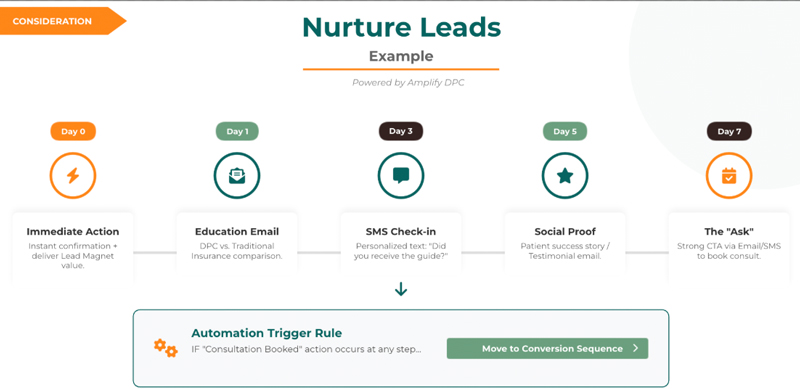
A simple automated sequence illustrates the pattern: an immediate confirmation and lead magnet on day zero, an educational email on day one comparing DPC to traditional insurance, a personalized check-in by day 3, a patient success story by day 5, and a clear call to action to book a consultation by day 7. A closer look at how these workflows fit together is worth it before you build one from scratch, since none of it should require a team member to remember who's due for a follow-up.
Conversion: Reducing Friction to Secure Commitment
By the time a patient reaches conversion, they're interested and engaged. The job now is removing every point of friction between that interest and a signed membership agreement.
A clear pipeline (lead, consultation scheduled, consultation held, agreement sent, converted) gives a practice visibility into exactly where prospects are getting stuck. Automated reminders sent by email, text, and voicemail cut down on no-shows, and an immediate rebooking sequence recovers a missed appointment without anyone on the team having to chase it manually. A referral workflow can extend that same automation to existing members, thanking referrers and nurturing the leads they send in without adding a manual task to anyone's day.
Once a patient says yes, the close should feel instant: an agreement ready for e-signature, a payment link that secures the membership commitment, and an internal task created automatically so onboarding starts without anyone dropping the ball. Practices that carry this same instinct into the next stage often add a patient education portal so a new member's questions keep getting answered long after the paperwork is signed. Every point of friction removed here is one less reason a patient reconsiders before the ink dries.
Compliance Considerations for Medical Practice Marketing
Marketing a medical practice online carries compliance obligations that general business marketing doesn't. HHS guidance on marketing under the HIPAA Privacy Rule gives individuals control over whether their protected health information gets used for marketing purposes, and in most cases requires their written authorization first.
Advertising claims face their own scrutiny too. FTC guidance on health-related advertising evaluates how a reasonable consumer would understand a claim, not just what the marketer intended by it, and looks at the whole ad rather than any single statement in isolation.
Any tool handling patient data needs to be built for compliance from the start. A HIPAA add-on that enables encryption of ePHI, signed Business Associate Agreements, audit logging, and multi-factor authentication is what makes automated patient communication legally defensible. A HIPAA-compliant CRM is a baseline requirement for any practice building automated outreach, not an optional upgrade.
See What's Actually Changed for Your Practice
Understanding these shifts is one thing. Putting a system behind them, one that handles awareness, consideration, and conversion together instead of as separate projects, is another. Book a demo with Amplify DPC and see how a platform built specifically for Direct Primary Care, Direct Specialty Care, and concierge medicine turns digital marketing for medical practices into one connected system your practice can actually run, instead of five separate tools.
Frequently Asked Questions
1. What does digital marketing for medical practices include?
It covers local SEO, a Google Business Profile, a website built to answer patient questions, content and lead magnets, paid advertising, social media, and the automated follow-up that carries a lead from first contact to a booked consultation.
2. How has digital marketing changed for medical practices?
Patients now research providers extensively before contacting them, often expecting direct answers rather than keyword-stuffed pages. Multi-channel follow-up and speed to first response also matter more than they used to, since a slow reply often means a lost lead.
3. Why does the patient journey take longer for DPC and concierge practices?
Most patients still don't know the membership model exists, so there's an education gap traditional clinics don't have to overcome. Patients are also opting in deliberately rather than being assigned to a provider, which means the practice has to earn that decision through consistent, trustworthy content.
4. What automation matters most for converting DPC leads?
Speed to lead and multi-channel follow-up make the biggest difference. Responding within the first five minutes and blending text, email, and calls over a week or two consistently outperforms a single follow-up email sent whenever staff finds time.
5. Is digital marketing worth it for a small medical practice?
Yes, particularly for membership-based practices that depend on patients understanding and choosing the model. A small practice with clear, well-optimized content and consistent follow-up can compete effectively against larger competitors with bigger budgets.
Key Takeaways
Treat awareness, consideration, and conversion as one connected system, not three separate marketing projects.
Build a website and content around the questions patients actually ask, especially about pricing and the membership model.
Respond to new leads within five minutes and follow up across at least two channels before writing a lead off.
Automate no-show prevention and rebooking so a missed appointment doesn't become a lost patient.
Confirm any platform handling patient data has a signed Business Associate Agreement, encryption, and audit logging in place before you rely on it.